

Walk into any motor factors or Halfords and you’ll be confronted by a wall of oil bottles, each one shouting something different at you. “Full synthetic.” “Semi-synthetic.” “Mineral.” “0W-40.” “10W-40.” Manufacturer-approved this, low-SAPS that. If you’re not a professional mechanic, it’s easy to just grab whatever’s cheapest and hope for the best. Don’t. The oil in your engine is doing more work than most drivers realise, and making the wrong call can cost you significantly more than the few quid you saved at the till.
The debate around synthetic vs mineral engine oil in the UK isn’t just marketing waffle, either. The British climate and driving patterns genuinely do introduce variables that change the equation compared to, say, driving in Southern Europe. So let’s strip this back properly.
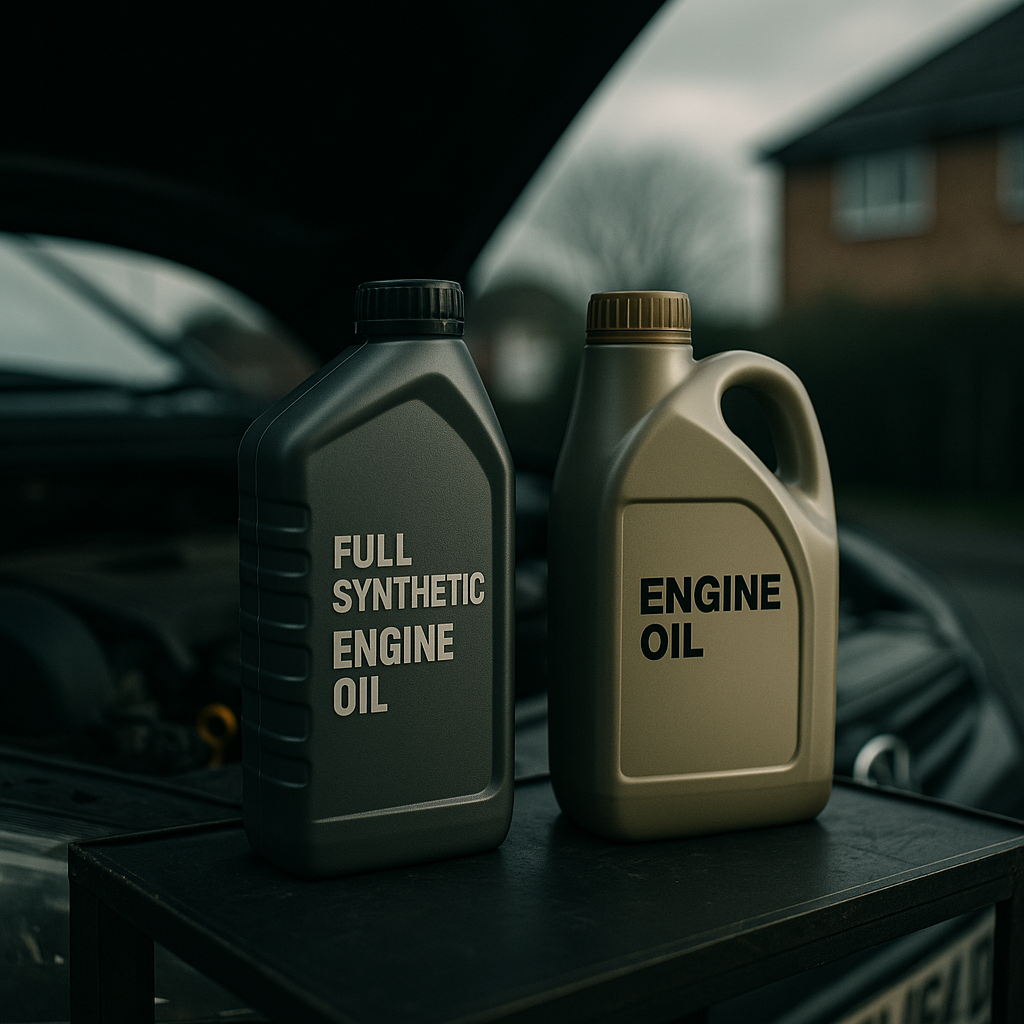
What Actually Is the Difference Between Synthetic and Mineral Oil?
Mineral oil is derived directly from crude oil that’s been refined. It’s been the engine lubricant of choice for most of motoring history and it does the job, but it has limitations. The base molecules aren’t uniform in size, which means performance degrades more quickly under heat and cold stress. It needs changing more frequently, typically every 6,000 to 8,000 miles depending on the engine.
Synthetic oil, whether fully synthetic or semi-synthetic, is engineered rather than simply extracted and refined. Full synthetics are built molecule by molecule (often from a chemical base like PAO, or polyalphaolefin), giving them far greater consistency, a much wider temperature operating range, and better resistance to oxidation and breakdown. Semi-synthetic is exactly what it sounds like: a blend of synthetic base stock and mineral oil, sitting between the two in terms of performance and cost.
The practical upshots: synthetic lasts longer, flows better in cold starts, and keeps working at higher engine temperatures. Mineral oil is cheaper upfront but degrades faster. Semi-synthetic sits in the middle on all counts. None of that is controversial. Where it gets more nuanced is deciding which one your car actually needs.
Viscosity Grades Explained: What Those Numbers Actually Mean
The numbers on the bottle, like 5W-30 or 10W-40, are viscosity grades set by the Society of Automotive Engineers (SAE). The “W” stands for winter, not weight, and the number before it indicates how the oil flows at low temperature. The number after describes viscosity at operating temperature, typically 100°C.
Lower W numbers flow more freely when cold. A 0W-30 will reach critical engine components faster during a cold start in January than a 15W-40 will. This matters enormously in the UK, where we get genuine cold snaps and a lot of short-distance urban driving where the engine never fully warms up. Cold-start wear accounts for a disproportionate amount of total engine wear across a car’s lifetime.
Higher viscosity at operating temp (the second number) gives you a thicker film of protection when things get hot, which suits high-performance or heavily loaded engines. For the majority of modern petrol and diesel cars on British roads, a 5W-30 full synthetic is broadly appropriate, but you need to check your specific vehicle’s handbook rather than assume.

Why Manufacturer Approvals Aren’t Just Marketing
This is the bit most people ignore, and it genuinely matters. Car manufacturers, particularly European ones, specify oils to tightly controlled standards. Volkswagen Group has its own approval system (VW 504.00, 507.00 and so on). BMW specifies LL-04 or LL-01 depending on the engine. Mercedes-Benz has its 229.5 and 229.51 specs. Renault, PSA, FIAT all have their own ratings on top of the standard ACEA classifications.
These aren’t arbitrary marketing exercises. Modern engines, particularly those with diesel particulate filters (DPFs), are sensitive to sulphated ash, phosphorus, and sulphur content in the oil. An oil that’s high in these compounds (known as a high-SAPS oil) can poison your DPF over time, which is an expensive problem. Low-SAPS full synthetics exist specifically to address this. If you’ve got a diesel with a DPF, which is nearly every diesel sold in the UK since around 2009, you need to be paying attention to SAPS content, not just viscosity.
The ACEA classifications on the bottle give you a starting point. C1, C2, C3, C4 designations all indicate low-SAPS formulations aimed at catalyst and DPF-equipped engines. A3/B4 and A5/B5 are common for petrol and diesel without those constraints. Cross-reference the ACEA code with whatever your handbook specifies, and you won’t go wrong.
How the UK Climate Tilts the Choice
Here’s where it gets genuinely interesting. The UK doesn’t get the prolonged deep freezes of Scandinavia or the baking summers of the Mediterranean. What we do get is relentless mild-cold, damp conditions, a lot of stop-start urban driving, and short runs that don’t give the engine time to reach optimal temperature. That combination is particularly brutal on mineral oil.
When an engine doesn’t fully warm up, water vapour and fuel contaminate the oil more rapidly. Mineral oil, with its less stable molecular structure, degrades faster under these conditions. A full synthetic handles the thermal cycling better and maintains its viscosity characteristics longer. If you do a lot of short hops around town, school runs, commutes of under ten miles, a full synthetic isn’t just a nice upgrade. It’s arguably the sensible choice even for an older, lower-mileage car that the manufacturer might have originally spec’d for semi-synthetic.
That said, very high-mileage older engines sometimes actually benefit from a slightly higher-viscosity semi-synthetic or even mineral oil. Worn tolerances can mean thinner synthetics allow too much seepage past seals. It’s one of those situations where the age and condition of the engine genuinely changes the answer. Worth bearing in mind if you’re running something with over 150,000 miles on the clock.
The RAC has some solid guidance on oil grades and change intervals that’s worth bookmarking: RAC Engine Oil Advice.
What Should You Actually Put in Your Car?
Right. Cut-to-the-chase time. The answer for most drivers is: check the handbook first, full stop. The manufacturer’s oil specification is the only authoritative answer for your specific engine. Once you’ve established what grade and ACEA/manufacturer approval is required, then you can decide between brands and synthetic levels.
For any modern car (roughly 2010 onwards) with a DPF or petrol particulate filter, you need a low-SAPS full synthetic meeting the relevant spec. That’s not a debate, that’s engineering. For older cars without those systems, a quality semi-synthetic often represents good value if the handbook permits it, though full synthetic will typically give you longer change intervals.
Don’t chase the cheapest unbranded bottle on the shelf. Oil specification matters more than brand prestige, but do buy from a recognised manufacturer. Castrol, Mobil 1, Shell Helix, Fuchs, Total, Comma, all well-established names available across the UK. Pay attention to the approval codes, not just the big marketing claims on the front of the bottle. And change it at the intervals the manufacturer specifies. Synthetic or not, old oil is worse than the wrong-grade fresh oil.
The synthetic vs mineral engine oil question in the UK ultimately comes down to three things: what your engine requires, what driving you actually do, and what condition the engine is in. Get those three factors right and the rest sorts itself out.
Frequently Asked Questions
Is full synthetic engine oil worth the extra cost for UK drivers?
For most modern cars in the UK, yes. Full synthetic oil lasts longer, performs better in cold starts (which are common in British weather), and handles short urban journeys much better than mineral oil. The higher upfront cost is generally offset by longer change intervals and better engine protection over time.
Can I switch from mineral to synthetic engine oil without problems?
In most cases, yes, provided the new oil meets your car’s manufacturer specification. Modern synthetics are fully compatible with mineral oil residues. However, in very high-mileage engines with worn seals, switching to a thinner synthetic can occasionally cause minor seepage, so it’s worth seeking advice for vehicles over 150,000 miles.
What does 5W-30 mean and is it right for my car?
5W-30 means the oil flows like a 5-weight fluid in cold conditions and a 30-weight at operating temperature. It’s one of the most commonly specified grades for modern UK cars, but you should always confirm the exact grade in your vehicle’s handbook rather than assuming. Using the wrong viscosity can affect performance and fuel economy.
Does my diesel car with a DPF need a special type of engine oil?
Yes, absolutely. Diesel cars fitted with a diesel particulate filter (DPF) require a low-SAPS full synthetic oil, typically meeting an ACEA C-class rating (C2, C3, or C4). Using a high-SAPS oil in a DPF-equipped engine can damage or block the filter, which is a very expensive repair.
How often should I change synthetic engine oil in the UK?
Most modern cars running full synthetic oil have change intervals of 10,000 to 12,000 miles, or annually if you cover fewer miles, but always follow your manufacturer’s recommendation. UK drivers doing a lot of short, cold-start journeys may benefit from erring towards the shorter end of any specified interval range.
Leave a Reply