Anyone retrimming an interior faces the same decision, and most people make it on appearance alone. Two years later they discover what they actually bought.
The three realistic options behave very differently, and the British climate is unusually good at exposing the difference.
Real leather
Leather is the benchmark for a reason. It breathes, it does not go clammy in summer, it develops a patina rather than simply wearing out, and a well-maintained hide will outlast the car.
The catch is that “well maintained” is doing serious work in that sentence. Leather is porous. It absorbs moisture and it absorbs body oils, and in a British winter a car interior spends months damp. Left alone, it dries out, the surface finish cracks, and once it has cracked there is no fixing it properly. It wants conditioning two or three times a year, and it wants a pH-neutral cleaner rather than whatever is under the sink.
Direct sunlight is the other killer. UV degrades the surface coating, which is why the top of a rear parcel shelf and the outer bolster of a driver’s seat always go first. South-facing driveway, no sunshade, ten years: that seat is done.
Best for: show cars, garaged cars, anyone who genuinely enjoys maintenance.
Marine-grade vinyl
Marine vinyl is engineered for boat interiors, which tells you everything. It is built to survive standing water, salt, sustained UV and repeated cleaning with things that would strip leather.
Modern marine grades are a long way from the sweaty plastic reputation vinyl earned in the seventies. Good ones have convincing grain, sensible flexibility in the cold, and antimicrobial treatment as standard because boat cushions grow mould otherwise. They are typically rated for thousands of hours of UV exposure, and they will genuinely take a pressure wash.
The compromise is breathability. Vinyl does not breathe, so on a hot day you will notice. That is the trade, and for a daily driver, a work vehicle, a camper or anything that sees wet gear thrown across the back seat, it is usually the right trade.
Best for: daily drivers, campers, working vehicles, anything that gets used rather than admired.
Polyurethane leather
PU sits between the two and its quality range is enormous. Good PU is genuinely difficult to tell from leather by touch, is more flexible than vinyl in cold weather, and breathes better than vinyl if not as well as hide.
The failure mode is specific and terminal: delamination. The polyurethane surface layer is bonded to a fabric backing, and when that bond fails the surface starts peeling in sheets. Heat and UV accelerate it. Once it starts, it cannot be repaired, only replaced.
Cheap PU can go within three years. Automotive-grade PU from a proper supplier will last far longer. Price is a reasonable proxy, and there is no sensible way to buy this material cheaply.
Best for: budget retrims where the look matters more than the twenty-year outcome.
The bit under the fabric
Whatever you choose on top, the foam underneath determines how the seat feels in five years.
Open-cell foam is cheap, comfortable when new, and compresses permanently. It also absorbs moisture, which in a damp car is how you end up with a seat that smells and never stops smelling. High-density closed-cell foam costs more, keeps its shape, and does not hold water.
If you are retrimming anyway, replace the foam. Putting a three-hundred-pound hide over a collapsed twenty-year-old seat base is a waste of the hide.
It is not just cars
The same three materials, and the same arguments, turn up anywhere something upholstered has to survive real use. Gym equipment, physiotherapy tables, marine seating, commercial furniture.
The furniture world in particular has had to think hard about materials that get folded and stored while slightly damp, which is a harsher environment than most car interiors ever see. There is a good breakdown of how these three materials age in practice written from that angle, and the conclusions map onto automotive retrimming almost exactly: marine vinyl for anything that gets used and cleaned, leather for anything that gets cherished, and be careful with cheap PU.
Short version
Garaged and loved: leather. Used hard, gets wet, needs cleaning: marine vinyl. Tight budget and you want the look: good PU, and accept the clock is ticking.
And replace the foam. Everyone regrets not replacing the foam.
There are few modifications that split the gearhead community quite like a remap. Half the crowd swears it’s the best £300 they ever spent; the other half has a story about a voided insurance policy or a blown turbo. The truth, as usual, sits somewhere in the middle. ECU remapping UK has gone from backstreet tuner territory to a mainstream service offered by franchised dealers and independent specialists alike, and the number of cars being remapped on British roads is climbing every year. Before you book yours in, though, there’s a fair bit worth understanding.
What an ECU Remap Actually Does
Your engine control unit (ECU) is essentially the brain of your car. From the factory, it runs on software calibrated by the manufacturer to hit a specific set of targets: fuel economy figures that look good in brochures, emissions that pass Euro 6 testing, and reliability margins wide enough to cope with terrible servicing habits and poor-quality fuel in dozens of different markets.
That’s not cynicism; it’s just engineering reality. A remap replaces or overwrites those factory parameters with a custom map tailored to your engine, your fuel grade, and your goals. A skilled tuner will adjust fuelling, ignition timing, boost pressure on turbocharged engines, rev limiters, and throttle response curves. Done properly on the right hardware, you can extract genuinely significant gains from engines that were conservatively mapped at the factory.
Turbocharged diesel engines tend to respond best. A 2.0-litre TDI that leaves the factory at 150 brake horsepower (bhp) might comfortably reach 190 bhp after a remap, with torque figures climbing even more impressively. Petrol turbo engines are similarly responsive. Naturally aspirated petrols are more limited; there’s only so much timing and fuelling can do when you’re not adding more air to the equation.
How Much Do Remaps Cost in the UK?
Prices vary considerably depending on where you go and what your car needs. A basic off-the-shelf Stage 1 remap from a reputable national chain like Viezu or Celtic Tuning typically sits between £250 and £500. Custom, dyno-proven remaps from specialist tuning shops can push £700 to £1,200 or more, particularly on performance cars or anything requiring hardware changes alongside the software work.
Cheaper options do exist, and that’s where caution is warranted. Generic maps downloaded and flashed remotely for £80 on a forum have caused real engine damage. The ECU of your 2.0 TDC Vauxhall Astra does not have the same tolerances as every other 2.0 TDC engine in existence; wear, fuelling quirks, and modifications all affect what a safe map looks like. A proper tuner will want to know your service history, check for faults, and ideally spend time on a rolling road.
ECU Remapping UK and Your Insurance Obligations
This is the bit that catches people out, and it matters enormously. In the UK, your motor insurance policy is a contract, and one of your core obligations is to disclose any modifications to your vehicle. An ECU remap is unambiguously a modification, even though it leaves no visible trace under the bonnet.
The problem is that a remap is essentially invisible. There’s no physical component to spot during an inspection. But insurers increasingly use Vehicle Identity Check (VIC) markers and forensic assessments after accidents to determine whether a car has been modified. If your remapped car is involved in a write-off and the insurer finds evidence of a tune, your policy can be voided. You could face a rejected claim, personal liability for third-party damages, and potentially a finding of driving without valid insurance.
The good news is that disclosure doesn’t automatically mean financial ruin. Many specialist insurers and brokers, including Adrian Flux, Footman James, and A-Plan, actively cover modified vehicles. You will pay more, typically 10 to 30 percent above standard premiums depending on the power increase, but that premium is a fraction of what an uncovered accident could cost you. For more on your legal obligations regarding vehicle modifications, the UK government’s vehicle approval guidance is worth a read alongside your insurer’s policy wording.
Does a Remap Affect Your MOT or Road Legality?
A Stage 1 remap on an otherwise standard car will almost always pass an MOT without issue. The emissions test uses fixed pass/fail thresholds rather than comparing against manufacturer specifications, so a well-tuned engine running cleanly will sail through. Where it gets complicated is when the remap is paired with an exhaust modification, EGR delete, or DPF removal. Those changes are where you start crossing lines with emissions law, and DVSA can and do issue prohibition notices on vehicles that have had emissions control equipment removed.
DPF deletes in particular are illegal for road use in the UK under the Road Vehicles (Construction and Use) Regulations 1986, regardless of what any tuner tells you. The police can issue fixed penalties, and MoT stations are required to fail any vehicle where evidence of tampering is found. Keep your remap to a software-only Stage 1 and leave the emissions hardware intact, and you’re on solid ground.
Choosing the Right Tuner for ECU Remapping in the UK
The market is not short of cowboys. My honest advice: look for tuners who are mapped on a rolling road (also called a dyno), who give you before-and-after power figures in writing, and who offer a money-back guarantee if the gains don’t materialise. Membership of the RMI (Retail Motor Industry Federation) or accreditation through organisations like Viezu’s own certification network is a reasonable indicator of professionalism.
Ask specifically whether they write a custom map for your individual car or load a generic file. Ask whether they do a pre-remap diagnostic check. Ask what happens if something goes wrong within the first 1,000 miles. Any tuner worth their salt will answer all three questions without hesitation.
It’s also worth noting that the precision of this kind of work shares a DNA with serious industrial engine management; the same attention to fuelling tolerances and timing accuracy that goes into tuning performance diesels is also what separates well-engineered heavy plant components from bodged ones. Even enthusiasts who’ve never looked at a Cat machine can appreciate why specialists in sectors like Caterpillar engine parts are obsessive about specification accuracy.
Are the Performance Gains Actually Worth It?
For turbocharged diesels and petrol turbos, honestly, yes, in many cases. A properly executed remap on a modern diesel estate can deliver noticeably better overtaking performance, improved fuel economy at motorway speeds (because you’re using less throttle to maintain pace), and a more alert throttle response in daily driving. The 30 to 40 bhp gain figures often quoted are real on the right platforms.
For naturally aspirated cars, the gains are modest, typically 5 to 10 bhp, and harder to justify financially. You might feel a slightly crisper throttle, but the £350 might be better spent on quality tyres.
The key variables are the engine platform, the quality of the tuner, and whether you’ve disclosed the mod to your insurer. Get those three right, and an ECU remap UK enthusiasts recommend is entirely achievable without drama. Get any one of them wrong, and it’s an expensive lesson.
Walk into any motor factors or Halfords and you’ll be confronted by a wall of oil bottles, each one shouting something different at you. “Full synthetic.” “Semi-synthetic.” “Mineral.” “0W-40.” “10W-40.” Manufacturer-approved this, low-SAPS that. If you’re not a professional mechanic, it’s easy to just grab whatever’s cheapest and hope for the best. Don’t. The oil in your engine is doing more work than most drivers realise, and making the wrong call can cost you significantly more than the few quid you saved at the till.
The debate around synthetic vs mineral engine oil in the UK isn’t just marketing waffle, either. The British climate and driving patterns genuinely do introduce variables that change the equation compared to, say, driving in Southern Europe. So let’s strip this back properly.
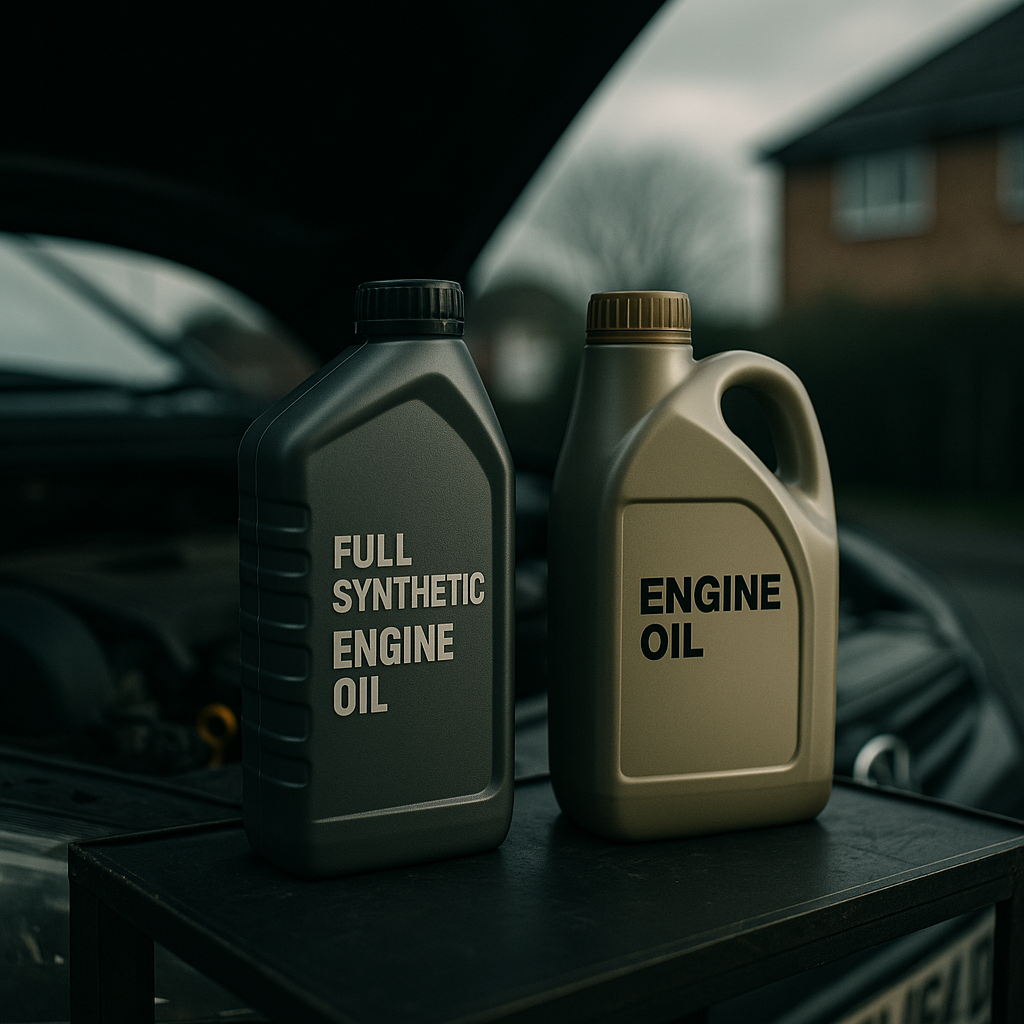
Full synthetic and mineral engine oil bottles compared on a UK garage workbench, illustrating the synthetic vs mineral engine oil UK debate
What Actually Is the Difference Between Synthetic and Mineral Oil?
Mineral oil is derived directly from crude oil that’s been refined. It’s been the engine lubricant of choice for most of motoring history and it does the job, but it has limitations. The base molecules aren’t uniform in size, which means performance degrades more quickly under heat and cold stress. It needs changing more frequently, typically every 6,000 to 8,000 miles depending on the engine.
Synthetic oil, whether fully synthetic or semi-synthetic, is engineered rather than simply extracted and refined. Full synthetics are built molecule by molecule (often from a chemical base like PAO, or polyalphaolefin), giving them far greater consistency, a much wider temperature operating range, and better resistance to oxidation and breakdown. Semi-synthetic is exactly what it sounds like: a blend of synthetic base stock and mineral oil, sitting between the two in terms of performance and cost.
The practical upshots: synthetic lasts longer, flows better in cold starts, and keeps working at higher engine temperatures. Mineral oil is cheaper upfront but degrades faster. Semi-synthetic sits in the middle on all counts. None of that is controversial. Where it gets more nuanced is deciding which one your car actually needs.
Viscosity Grades Explained: What Those Numbers Actually Mean
The numbers on the bottle, like 5W-30 or 10W-40, are viscosity grades set by the Society of Automotive Engineers (SAE). The “W” stands for winter, not weight, and the number before it indicates how the oil flows at low temperature. The number after describes viscosity at operating temperature, typically 100°C.
Lower W numbers flow more freely when cold. A 0W-30 will reach critical engine components faster during a cold start in January than a 15W-40 will. This matters enormously in the UK, where we get genuine cold snaps and a lot of short-distance urban driving where the engine never fully warms up. Cold-start wear accounts for a disproportionate amount of total engine wear across a car’s lifetime.
Higher viscosity at operating temp (the second number) gives you a thicker film of protection when things get hot, which suits high-performance or heavily loaded engines. For the majority of modern petrol and diesel cars on British roads, a 5W-30 full synthetic is broadly appropriate, but you need to check your specific vehicle’s handbook rather than assume.
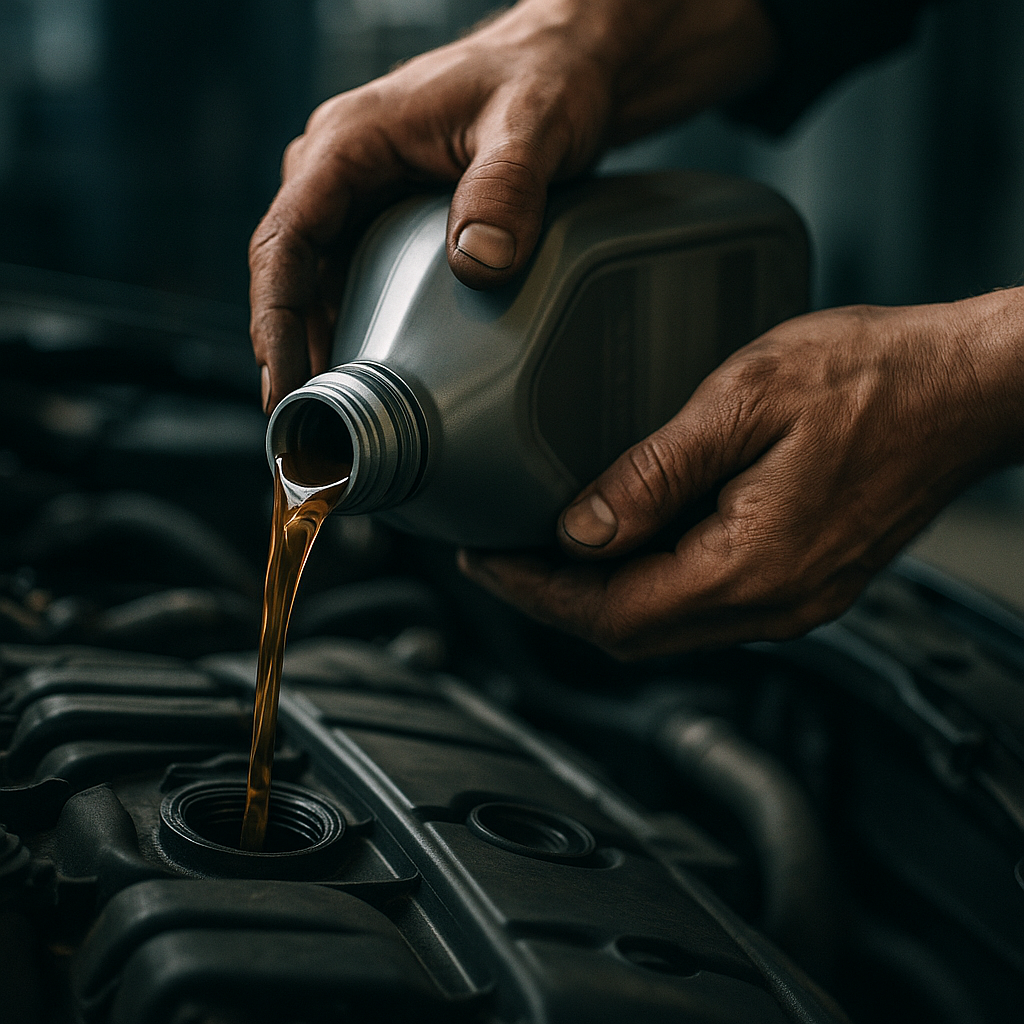
Mechanic pouring synthetic engine oil into a car engine, showing viscosity grade selection relevant to synthetic vs mineral engine oil UK choices
Why Manufacturer Approvals Aren’t Just Marketing
This is the bit most people ignore, and it genuinely matters. Car manufacturers, particularly European ones, specify oils to tightly controlled standards. Volkswagen Group has its own approval system (VW 504.00, 507.00 and so on). BMW specifies LL-04 or LL-01 depending on the engine. Mercedes-Benz has its 229.5 and 229.51 specs. Renault, PSA, FIAT all have their own ratings on top of the standard ACEA classifications.
These aren’t arbitrary marketing exercises. Modern engines, particularly those with diesel particulate filters (DPFs), are sensitive to sulphated ash, phosphorus, and sulphur content in the oil. An oil that’s high in these compounds (known as a high-SAPS oil) can poison your DPF over time, which is an expensive problem. Low-SAPS full synthetics exist specifically to address this. If you’ve got a diesel with a DPF, which is nearly every diesel sold in the UK since around 2009, you need to be paying attention to SAPS content, not just viscosity.
The ACEA classifications on the bottle give you a starting point. C1, C2, C3, C4 designations all indicate low-SAPS formulations aimed at catalyst and DPF-equipped engines. A3/B4 and A5/B5 are common for petrol and diesel without those constraints. Cross-reference the ACEA code with whatever your handbook specifies, and you won’t go wrong.
How the UK Climate Tilts the Choice
Here’s where it gets genuinely interesting. The UK doesn’t get the prolonged deep freezes of Scandinavia or the baking summers of the Mediterranean. What we do get is relentless mild-cold, damp conditions, a lot of stop-start urban driving, and short runs that don’t give the engine time to reach optimal temperature. That combination is particularly brutal on mineral oil.
When an engine doesn’t fully warm up, water vapour and fuel contaminate the oil more rapidly. Mineral oil, with its less stable molecular structure, degrades faster under these conditions. A full synthetic handles the thermal cycling better and maintains its viscosity characteristics longer. If you do a lot of short hops around town, school runs, commutes of under ten miles, a full synthetic isn’t just a nice upgrade. It’s arguably the sensible choice even for an older, lower-mileage car that the manufacturer might have originally spec’d for semi-synthetic.
That said, very high-mileage older engines sometimes actually benefit from a slightly higher-viscosity semi-synthetic or even mineral oil. Worn tolerances can mean thinner synthetics allow too much seepage past seals. It’s one of those situations where the age and condition of the engine genuinely changes the answer. Worth bearing in mind if you’re running something with over 150,000 miles on the clock.
The RAC has some solid guidance on oil grades and change intervals that’s worth bookmarking: RAC Engine Oil Advice.
What Should You Actually Put in Your Car?
Right. Cut-to-the-chase time. The answer for most drivers is: check the handbook first, full stop. The manufacturer’s oil specification is the only authoritative answer for your specific engine. Once you’ve established what grade and ACEA/manufacturer approval is required, then you can decide between brands and synthetic levels.
For any modern car (roughly 2010 onwards) with a DPF or petrol particulate filter, you need a low-SAPS full synthetic meeting the relevant spec. That’s not a debate, that’s engineering. For older cars without those systems, a quality semi-synthetic often represents good value if the handbook permits it, though full synthetic will typically give you longer change intervals.
Don’t chase the cheapest unbranded bottle on the shelf. Oil specification matters more than brand prestige, but do buy from a recognised manufacturer. Castrol, Mobil 1, Shell Helix, Fuchs, Total, Comma, all well-established names available across the UK. Pay attention to the approval codes, not just the big marketing claims on the front of the bottle. And change it at the intervals the manufacturer specifies. Synthetic or not, old oil is worse than the wrong-grade fresh oil.
The synthetic vs mineral engine oil question in the UK ultimately comes down to three things: what your engine requires, what driving you actually do, and what condition the engine is in. Get those three factors right and the rest sorts itself out.
Frequently Asked Questions
Is full synthetic engine oil worth the extra cost for UK drivers?
For most modern cars in the UK, yes. Full synthetic oil lasts longer, performs better in cold starts (which are common in British weather), and handles short urban journeys much better than mineral oil. The higher upfront cost is generally offset by longer change intervals and better engine protection over time.
Can I switch from mineral to synthetic engine oil without problems?
In most cases, yes, provided the new oil meets your car’s manufacturer specification. Modern synthetics are fully compatible with mineral oil residues. However, in very high-mileage engines with worn seals, switching to a thinner synthetic can occasionally cause minor seepage, so it’s worth seeking advice for vehicles over 150,000 miles.
What does 5W-30 mean and is it right for my car?
5W-30 means the oil flows like a 5-weight fluid in cold conditions and a 30-weight at operating temperature. It’s one of the most commonly specified grades for modern UK cars, but you should always confirm the exact grade in your vehicle’s handbook rather than assuming. Using the wrong viscosity can affect performance and fuel economy.
Does my diesel car with a DPF need a special type of engine oil?
Yes, absolutely. Diesel cars fitted with a diesel particulate filter (DPF) require a low-SAPS full synthetic oil, typically meeting an ACEA C-class rating (C2, C3, or C4). Using a high-SAPS oil in a DPF-equipped engine can damage or block the filter, which is a very expensive repair.
How often should I change synthetic engine oil in the UK?
Most modern cars running full synthetic oil have change intervals of 10,000 to 12,000 miles, or annually if you cover fewer miles, but always follow your manufacturer’s recommendation. UK drivers doing a lot of short, cold-start journeys may benefit from erring towards the shorter end of any specified interval range.